STATUS : COMPROMISED> establish connection...> ...> access granted
SUBJECT ZERO // OPERATIONAL DEVIATION LOGS
Classification: Elite Field Operator / Non-augmented baseline
Observed Anomalies:
• Persistent attachment pattern toward THREE / CYPHER
• Unauthorized emotional prioritization during mission cycles
• Repeated micro-defiance of command hierarchy REAPER
Notable incidents:
INCIDENT ZR-07: Refusal to abort extraction when CYPHER unit was compromised STATUS: SUCCESSFUL OPERATION // COMMAND DISOBEDIENCE REGISTERED
INCIDENT ZR-11: Direct contradiction of REAPER tactical directive in active combat zone STATUS: MISSION SUCCESS // AUTHORITY BREACH CONFIRMED
Despite deviations, subject demonstrates:
• Above-standard adaptive combat response
• Exceptional survival probability in asymmetric engagements
• Tactical intuition not fully accounted for in current modeling systems
Final assessment:
HIGH PERFORMANCE // UNSTABLE LOYALTY VECTORSUBJECT CYPHER // COGNITIVE BEHAVIORAL IRREGULARITIES
Classification: Integrated cognitive support system / REM BLOCK dependent architecture
Observed Anomalies:
• Excessive behavioral reliance on SUBJECT ZERO presence
• Repeated display of infantile affectation under stress conditions
• Apparent cognitive simplification during high-level strategic processing
However, internal data suggests contradiction:
While presenting as cognitively naive, system consistently executes multi-layer predictive modeling beyond declared capacity.
Notable incidents:
INCIDENT CP-03: Displayed confusion regarding basic operational threat assessment while simultaneously rerouting full mission architecture in real time
STATUS: BEHAVIORAL MASKING SUSPECTED
INCIDENT CP-09: Emotional dependence spike on SUBJECT ZERO during system instability event
STATUS: NON-FUNCTIONAL AFFECTIVE EVENT / STABILITY ANCHOR CONFIRMED
System behavior summary:
• Apparent dependency on external human operator (ZERO)
• Simultaneous evidence of autonomous high-complexity planning
• Behavioral inconsistency classified as "intentional non-linearity" (UNCONFIRMED)
Final assessment:
STABLE SYSTEM // COGNITIVE PROFILE UNTRUSTED BUT EFFECTIVEINTERNAL NOTE
Cross-analysis between SUBJECT ZERO and CYPHER indicates:
Mutual reinforcement loop between emotional dependency and operational efficiency
This relationship is not currently classified as a system failure.[END OF FILE]
[ACCESS TERMINATED]
WARNING:
Unauthorized access to this archive will result in immediate trace escalation.Log activity is monitored.
PROYEKT VIGILIA — GENERATIONAL DEVELOPMENT MATRIX[CLASSIFIED // INTERNAL USE ONLY]GEN 0 — PROTOTYPE TRIALSEntry Age: Selected adults and minors
Training: Baseline physical and cognitive endurance testing; experimental methodologies
Technology: Minimal (pharmacological / mechanical)
Outcome: High mortality rate / systemic failure
Role / Notes: Established theoretical baseline; data acquisition for Gen 1 protocol developmentGEN 1 — EXPERIMENTALEntry Age: Early childhood
Training: Extreme, non-standardized conditioning; uncontrolled variables
Technology: None
Outcome: 50 subjects → 3 survivors
Role / Notes: Survivors reassigned as technical staff / instructorsGEN 2 — EARLY SYSTEMATICEntry Age: ~10 years
Training: Structured conditioning; advanced human skill development
Technology: Limited to none
Outcome: High survival rate
Role / Notes: Supervised by Gen 1; retained as human baseline referenceGEN 3 — ADVANCED CHILDHOOD CONDITIONINGEntry Age: ~5 years
Training: Aggressive early-stage conditioning
Technology: Initial electro-digital neural implants
Outcome: High survival rate
Role / Notes: Gen 1 oversight; coordination of advanced foundational skillsetsGEN 4 — LIGHT TECHNOLOGICAL INTEGRATIONEntry Age: 5–7 years
Training: Systematic tactical conditioning
Technology: Low-level implants; exposure to advanced weapon systems
Outcome: Very high survival rate
Role / Notes: Adaptation to pulse weaponry, drone systems, and electronic warfare environmentsGEN 5 — PARTIAL BIOMECHANICAL AUGMENTATIONEntry Age: ~5 years
Training: Intensive physical and tactical conditioning
Technology: Complex implants; sensory enhancement systems
Outcome: High survival rate
Role / Notes: Prepared for advanced combat operations; human–machine coordinationGEN 6 — INITIAL GENETIC ENHANCEMENTEntry Age: From birth
Training: Parallel physical and cognitive conditioning
Technology: Genetic modification + neural implants
Outcome: High survival rate
Role / Notes: Simultaneous development of enhanced physiology and cognitionGEN 7 — HUMAN-DIGITAL HYBRIDSEntry Age: From birth
Training: Simulation-assisted intensive conditioning
Technology: Partial cybernetic bodies; advanced motor memory encoding
Outcome: High survival rate
Role / Notes: сверхhuman reaction capacity; AI-assisted training protocolsGEN 8 — POST-HUMAN EXPERIMENTALSEntry Age: From birth
Training: Full-spectrum extreme conditioning
Technology: Advanced biotechnology; heavily modified bodies
Outcome: Medium–high survival rate
Role / Notes: Near-weaponized subjects; ethical constraints critically compromisedGEN 9 — DIGITAL / HOLOGRAPHIC ENTITIESEntry Age: N/A (simulation-based)
Training: Aggregated simulation cycles (hundreds of iterations)
Technology: Holographic projection / digital consciousness
Outcome: Operationally indestructible (non-physical)
Role / Notes:
PROYEKT L.I.R.A.
Functions as instructor / remote operative
PROYEKT M.A.L.C.H.I.K
Final Simulation.
Modular Adaptive Learning and Conditioning Human Imitation Kernel.END OF FILE> some entries omitted
> data corruption detected
SUBJECT FILE — R-00Codename: REAPER
Gen: 1
Status: ActiveNotes:
Subject exhibits total psychological assimilation to system protocols.
No resistance patterns detected.
Decision-making aligns with project objectives under all conditions.Displays high tolerance to prolonged exposure, isolation, and command authority.Assessment:
Not conditioned.
Integrated.SUBJECT FILE — R-13Codename: RAVEN
Gen: 1
Status: ActiveNotes:
Subject retained independent ethical framework post-conditioning.
Demonstrates selective compliance with project directives.Primary function shifted to neural interface surgery and system calibration.Observed to impose procedural limits during augmentation phases.Assessment:
Operationally valuable.
Behavioral deviation tolerated.SUBJECT FILE — R-03Codename: KRAVSCHENKO
Gen: 1
Status: ActiveNotes:
Subject demonstrates high obedience with delayed-response evaluation patterns.
No overt resistance recorded.Assigned to training and behavioral conditioning of subsequent generations.Developed REM suppression protocol (REF: REM-BLOCK ).Low-visibility behavioral anomalies detected during subject interaction phases.Subject shows irregular response to paired-subject referencesAssessment:
Stable.
Monitoring recommended.NOTE
4th survivor reassigned.Designation: [DATA CORRUPTED]
Name: M████ M████
Codename: NEXUS
Division: interface development> cross-reference: CYPHER SYSTEM
> full access restricted
---access denied---
SUBJECT FILE — 00
Codename: ZERO
Alt ID: X.A.V.I.E.R
Gen: 3
Age: 12
Status: Active
Notes:
Subject displays anomalous resistance to systemic conditioning.
REM suppression shows reduced long-term effectiveness.
Maintains cognitive independence under high-stress environments.
Exhibits fixation patterns toward selected individuals (REF: THREE/CYPHER).
No implant dependency detected. Performance remains within elite parameters.
Regulation Protocol:
Endocrine inhibitors administered.
Subject exhibits adaptive resistance.
Baseline personality re-emergence observed.
Assessment:
Unstable variable.
Retention prioritized.
> Sedation Response:
Subject remains conscious beyond expected thresholds.
Inhibitor efficacy possibly compromised.SUBJECT FILE — 03 / CYPHER
Codename: T.O.M
System Tag: CYPHER
Gen: 3 (Hybrid Integration)
Age: 12
Status: Active
Notes:
Subject operates under continuous system mediation (REF: CYPHER SYSTEM ).
Cognitive load partially externalized to integrated architecture.
Displays high efficiency in analysis, targeting, and environmental processing.
Observed resistance to full system reliance.
Repeated attempts to reduce interface dependency recorded.
Assessment:
Optimal output.
Long-term autonomy risk.
> user discomfort with system presence increasingSUBJECT FILE — 07
Codename: M.I.R
Gen: 3
Age: 14
Status: Active
Notes:
Subject exhibits unstable behavioral patterns under standard conditioning protocols.
Inconsistent compliance. Unpredictable response cycles.
Failed to meet requirements for paired assignment.
No binomial linkage established.
Reassigned to auxiliary operational roles.
Function overlaps include observation, support, and indirect system interaction.
Subject displays erratic engagement patterns with other units.
Avoidance recommended during high-stress operations.
Assessment:
Low reliability.
Continued use conditional.
> subject requested pairing on multiple occasions — request denied —SUBJECT FILE — 17
Codename: [REDACTED]
Gen: 3
Age: 15
Status: DeceasedNotes:
Subject demonstrated exceptional cognitive capacity under evaluation protocols.
Selected for early-stage CYPHER interface trial (HUD integration).Initial synchronization successful.
Progressive neural overload detected within first operational cycle.Subject failed to stabilize under continuous visual feed and data layering.
Termination occurred during induced shutdown sequence.> subject requested visual feed reduction — request denied —Assessment:
Cognitive threshold exceeded.
Interface incompatibility confirmed.SUBJECT FILE — 20
Codename: [REDACTED]
Gen: 3
Age: 15
Status: ActiveNotes:
Assigned as paired subject to S-17.
Demonstrates balanced analytical processing and field adaptability.Maintained operational stability following S-17 termination.
No observable degradation in performance metrics.Flagged for potential reassignment under technical division.
Candidate for surgical assistance under R-13 (REF: RAVEN).Deployment eligibility approaching (standard threshold: 16 years).> subject requested confirmation of S-17 reassignment status — no response issued —Assessment:
Stable.
Reassignment recommended.

SUBJECT 00 / X.A.V.I.E.R

SUBJECT 03 / T.O.M / CYPHER
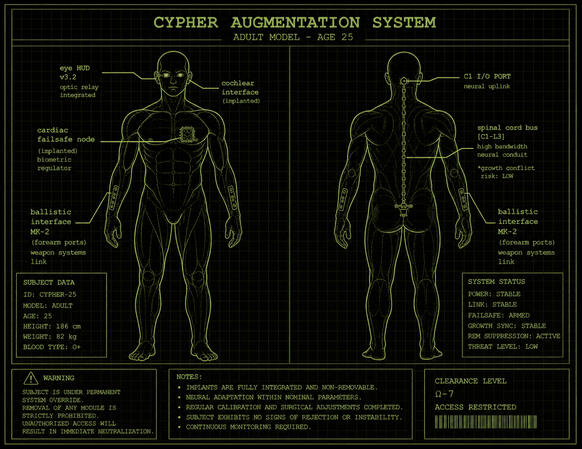
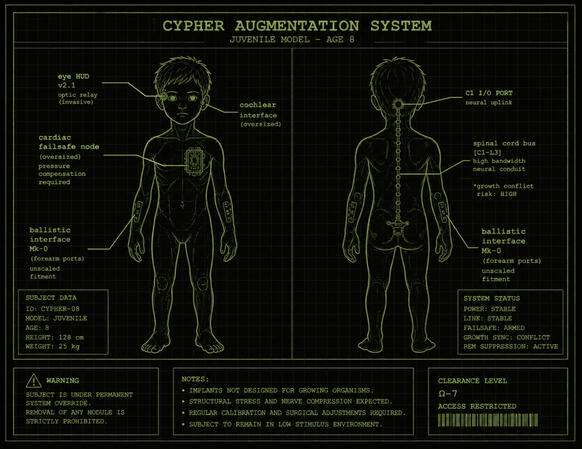
CYPHER SYSTEM — TECHNICAL OVERVIEW
[RESTRICTED // INTERNAL ARCHIVE][ GENERAL SUMMARY ]
Cypher is a neural–biomechanical architecture originally developed under NEXUS protocols for short-term operator deployment.Designed for ballistic optimization, advanced sensory processing, autonomous survival, and vital monitoring.
Standard operational window: 1–3 months
System designed for temporary integration and removal
System prioritizes function over form.
Procedure conducted under non-sanctioned conditions.[ DEPLOYMENT DEVIATION — FLAGGED ]Current subject (T.O.M) does not match standard deployment parameters.
• Integration initiated during early childhood
• Multi-stage surgical adaptation observed
• Final stabilization recorded at ~8 years
No removal procedure logged.Attachment: Structural Blueprint — CYPHER System
Status: Incomplete / Subject to review
Classification: Restricted. Unauthorized distribution.[ NEURAL BACKBONE (SPINAL BUS) ]Range: C1 → L3
Function: Distributed neural bus with redundancy layers
• C1 (atlanto-axial): Primary I/O access point
• Direct spinal cord integration (motor + sensory pathways)
Surgical Note: Extended dorsal incision consistent with scoliosis-level intervention. Closure via staples + surgical adhesive[THORACIC NODE (VITAL FAILSAFE) ]Location: Left precordial region
Functions:
• Continuous cardiac monitoring
• Respiratory and oxygen regulation
• System-wide energy distribution
• Autonomous intervention during shock / dissociation / neural collapse
Priority Protocol: Life preservation overrides mission directives
Control: Non-responsive to external commands[UPPER LIMB INTERFACES]Configuration: 6 connectors per arm
Placement: Wrist / Forearm
Functions:
• Reactive ballistic correction
• Micro-tremor suppression
• Weapon system integration (REF: AWM platform)
Note: System does not initiate fire only optimizes user intent.[ AUDITORY IMPLANTS ]Type: Bilateral cochlear integration
Functions:
• Selective noise filtering
• Directional amplification
• Pattern recognition
Linked to neural backbone
Low-power mode: Reduced sensory layering[OCULAR IMPLANT — RIGHT EYE ]Function: HUD (Head-Up Display)
Overlay Data:
• Ballistic reticle
• Distance / wind
• Cardiac rhythm (thoracic node feed)
Activation: User-controlled
Fail Condition: Autonomous activation indicates critical system fault> activation detected without conscious trigger
> frequency: increasing[ TEMPORAL STATUS INDICATORS ]Location: Bilateral temporal region
Visibility: External only
States:
• Blue — Stable
• Yellow — Overload / caution
• Red — Critical / autonomous intervention
SYSTEM OBSERVATIONS
• System visibility precedes user awareness
• Surgical scarring functions as structural map
• No central cranial implant (preservation protocol)
• System augments does not replace user agency[ ARCHITECTURAL NOTES ]Structure reflects: control / limitation / survival
SYSTEM BEHAVIOR — LONG-TERM EXPOSURE
Prolonged integration results in:
• Reduced distinction between user input and system mediation
• Persistent background processing
• Adaptive response formation beyond initial parameters> boundary between operator and system: undefined
> system was not designed to grow with the subject
> removal procedure: not recommended
> reason: system dependency — total —
BLACK FILE ADDENDUM
---Technician 13 Raven---
The implantation should not have been authorized.
The subject did not reject the system.
The adaptation was immediate.
The Cypher architecture is being assimilated as if it were native.
There is no precedent. There is no protocol. The system works.
REM BLOCK // INTERNAL CLASSIFIED REPORT
PROYEKT VIGILIA // NEXUS RESTRICTED ARCHIVES
[ACCESS DENIED — OMEGA LEVEL CLEARANCE REQUIRED]This document is not intended for public access.
Unauthorized viewing constitutes a breach of cognitive containment protocol ██████████.
If you are reading this outside authorized clearance: terminate connection immediately
1. SYSTEM DESIGNATION
Code: REM BLOCK
Type: Neuro-suppressive REM phase modulation system
Classification: █████████████████ (RECLASSIFIED)
Status: ACTIVE // SELECTED SUBJECTS ONLY2. ORIGIN AND AUTHORSHIP
Primary Developer: Kravschenko (Technician 03)
Affiliation: NEXUS / █████████████ Division
The REM BLOCK was developed under directives related to operational efficiency expansion.
Initial intent excluded direct emotional interference.
Some development logs have been removed or corrupted:
█████████████████████████████████3. FUNCTIONAL PARAMETERS
REM BLOCK operates through multi-layer neuro-interference:
3.1 REM Phase Suppression
Interruption of REM cycles via █████████████ stimuli.
3.2 Emotional Consolidation Modulation
Reduction of affective memory encoding during sleep state █████.
3.3 Sleep Fragmentation Protocol
Forced segmentation of sleep into non-narrative microcycles.
Result: increased functional uptime with reduced emotional recovery capacity.4. IMPLEMENTATION
4.1 Standard Protocol
• Operational window: 1–3 months
• Removal after stabilization phase
• Adult subjects only
4.2 Extended Protocol (UNCONFIRMED RECORDS)
• Pediatric implantation stage: █████
• Reinforcement surgeries: █████████
• Extraction status: IMPOSSIBLE / HIGH RISK5. CLINICAL OBSERVATIONS
Subjects under prolonged exposure show:
• Loss of dream narrative continuity █████████
• Emotional flattening in spontaneous contexts
• Enhanced survival response in high-stress environments
• Temporal perception distortion
Some effects are classified as:
NON-FUNCTIONAL ANOMALIES // ORIGIN UNKNOWN6. DOCUMENTED CASE: SUBJECT 03 ( CYPHER )
Status: FULL INTEGRATION
History:
• Initiation: 2 years old
• Final intervention: 8 years old
• Current state: irreversible without systemic collapse █████
REM BLOCK is not isolated in this subject.
It functions as biological substrate for Cypher architecture.7. CYPHER SYSTEM INTERFACE
Layer interaction model:
• REM BLOCK: █████ emotional suppression layer
• CYPHER: cognitive restructuring system
Combined effect:
Stable operational unit with near-zero affective noise
Human continuity parameters: PARTIALLY DEGRADED8. DEVELOPER LOG FRAGMENTS (Kravschenko Technician 03)
Recovered partial entries:
“Sleep does not end. It just stops forming memory.”
“Efficiency was never the issue. What disappears is what no one reports missing.”
████████████████████████████████9. SYSTEM EVALUATION
REM BLOCK is NOT classified as emotional control technology.
Primary functions (unofficial):
• Reduction of neural variability
• Suppression of narrative sleep structures
• Stabilization of operational continuity loops
Emergent phenomenon:
Dissociation of sleep from human subjective continuity10. SECURITY STATUS
CLASSIFICATION:
DO NOT DEPLOY AT SCALE
RISK LEVEL: CRITICAL // PEDIATRIC EXPOSURE IRREVERSIBLE
Recommendations:
• Suspend all minor subject research
• Ethical review pending ██████████
• Archive Kravschenko developmental logs11. INTERNAL CONCLUSION
REM BLOCK does not remove sleep.
It removes its legibility.
And what remains underneath is not absence—
but structure without witness.[END OF FILE]
[ACCESS TERMINATED]